Something Shifts Up Here: How Monchique's Mountains Change the Way You Connect With People
You probably didn't book a trip to the Monchique mountains expecting a relationship breakthrough. Maybe you came for the trails, or the cork forests, or because someone online said it was the part of Portugal everyone forgets to visit. But ask almost anyone who's spent more than a couple of days up here, and they'll tell you the same thing: the people stuff hit them harder than the scenery.
There's a name for it, informal as it is. Locals and repeat visitors have started calling it the Monchique Effect—that odd, almost uncomfortable feeling of actually being present with the people around you. No scrolling through feeds at dinner. No half-listening while mentally composing emails. Just the woodsmoke, the eucalyptus air, and whoever's sitting across from you.
Why Altitude Has Nothing to Do With It (And Everything to Do With It)
At roughly 2,950 feet, Fóia—the highest peak in southern Portugal—isn't going to leave you gasping for breath. But something about being above the coastal noise floor does something to your nervous system. Researchers who study what's sometimes called "awe experiences" in nature have found that exposure to vast, quiet landscapes tends to slow our internal clock. We stop anticipating the next thing. We stop performing.
That's not a small deal for Americans, who tend to travel the way they do everything else—efficiently, with a plan, and slightly behind schedule. Monchique has a way of dismantling that approach within about 48 hours. The roads are narrow and winding. The villages don't have much in the way of organized entertainment. And if you lose cell service on a trail, which you will, the person next to you becomes your whole world for a little while.
"I've traveled with my college friends probably a dozen times," said one visitor from Chicago who spent a week hiking out of Monchique town last spring. "We always have a great time, but we also always end up in our own bubbles—podcasts, phones, whatever. Up here, there was nothing to retreat into. By day three, we were having conversations we hadn't had in years."
Solo Travelers and the Unexpected Community
For people traveling alone, Monchique has a particular kind of magic. It's not a backpacker hub. There are no hostels with neon signs and organized pub crawls. What it has instead is a slower, more organic social ecosystem—guesthouses where breakfast is communal, trailheads where strangers naturally fall into step together, and village cafés where the owner knows your name by your second coffee.
Several solo American travelers described a similar experience: arriving slightly anxious about being on their own, and leaving with friendships that outlasted the trip. One woman from Portland who visited during the off-season said she ended up spending two evenings with a Portuguese couple she met on the trail to Picota peak. "We barely spoke the same language," she laughed. "But we shared a thermos of medronho and watched the clouds roll in below us, and that was enough. We still message each other."
That's the thing about shared physical experience—it bypasses a lot of the small talk that usually precedes real connection. When you've climbed something together, or gotten slightly lost together, or watched the same sunset from a ridge you almost didn't reach, you've already done the work that most friendships take months to accomplish.
Families Reconnecting Without a Script
Parents traveling with teenagers have a particularly interesting time in Monchique. The usual bargaining chips—screens, shopping, scheduled activities—are largely off the table. What's on the table is a lot of hiking, a lot of meals that take longer than expected, and a lot of unstructured time in places beautiful enough to hold attention without any help.
"My kids complained for the first day," admitted a father from Austin who brought his 14- and 16-year-olds on a ten-day Portugal trip that included three nights in the mountains. "By day two they were leading us on trails they'd found on a map. By day three my daughter was asking the café owner about the history of the town. I hadn't seen her curious like that in a while."
It's not that Monchique has some secret formula for family harmony. It's more that it removes the friction points—the competing schedules, the overstimulation, the sense that everyone should be somewhere more exciting. When the environment itself is interesting enough, the pressure to perform a good vacation lifts. And in that space, families tend to find each other again.
Practical Ways to Lean Into the Connection
If you're heading to Monchique with people you care about—or hoping to meet people you'll care about—here are a few things that seem to make the difference:
Book somewhere with shared space. Guesthouses and small rural properties (quintas) with communal kitchens or dining areas naturally encourage conversation. Isolation is great for the soul; total isolation can work against the social magic.
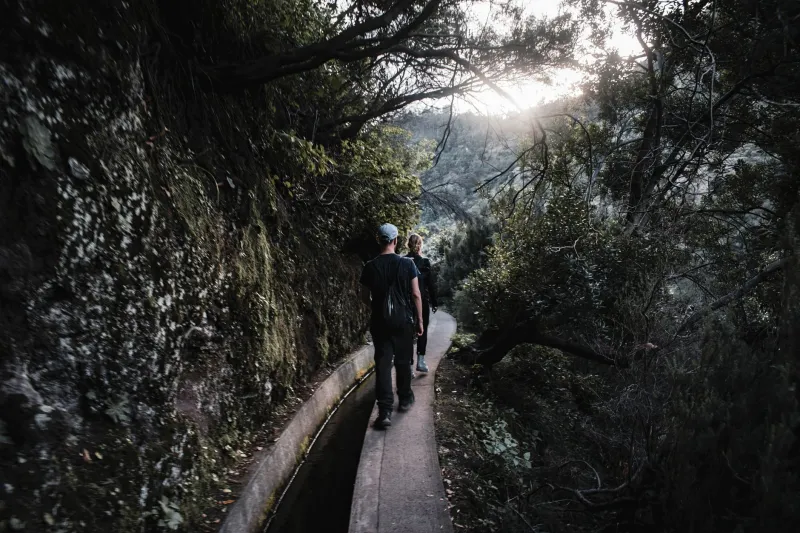
Pick at least one long trail together. The hike from Monchique town up toward Fóia takes a few hours and involves enough challenge that you'll be talking the whole way—about the landscape, about your lives, about things you didn't know you wanted to say. The Rota Vicentina connections through the foothills are worth exploring too.
Eat slowly and eat local. A long lunch at a restaurant in Caldas de Monchique, the village built around the thermal springs, is basically enforced intimacy. There's nowhere to be. Order the black pork. Share the wine. Let the meal take two hours.
Put the phones away before you need to. Don't wait for the signal to drop. Make it a deliberate choice on the first morning. The absence of the option to check out is what creates the conditions for checking in.
Leave room for nothing. The instinct to fill every hour is strong. Resist it. Some of the best conversations that happen in Monchique happen when two people are sitting on a stone wall watching a valley fill with afternoon light, with absolutely nowhere to be.
What You Bring Back Down
The tricky part of the Monchique Effect is that it doesn't automatically survive the descent. You drive back down toward the Algarve coast, and slowly the notifications return, the pace picks up, and the person you were in the mountains starts to feel like a version of yourself you can't quite hold onto.
But people who've traveled here say the relationships forged or deepened in those hills tend to stick in a way that other travel friendships don't. Maybe because they were built on something real—shared effort, shared quiet, shared meals that no one photographed.
Monchique doesn't promise transformation. It just creates the conditions for it. What you do with that is up to you.