Once Is Never Enough: The Quiet Pull That Keeps Drawing Americans Back to Monchique
Most vacations fade. You come home with a tan, a few photos, maybe a bottle of something you can't find at Total Wine, and within two weeks the whole thing has compressed itself into a highlight reel you scroll past on your phone. That's just how travel works, right?
Not always. And not, it turns out, for a surprisingly consistent group of American travelers who've found their way to the Monchique mountains in southern Portugal's Algarve hinterland — and then found their way back. Again. Sometimes again after that.
This isn't a niche phenomenon. Talk to the owners of small guesthouses scattered through the cork-oak hills above Portimão, and they'll tell you the same thing: a meaningful chunk of their guests are returnees. People who visited once, went home to Denver or Atlanta or Portland, and started quietly planning their next trip before the jet lag had even cleared.
So what's actually happening here?
The Decompression Nobody Expected
Sarah, a project manager from Austin who first visited Monchique three years ago and has returned twice since, describes her initial arrival the way a lot of people describe theirs: with mild confusion.
"I'd done Lisbon, I'd done the Algarve coast. A friend suggested we drive up into the mountains for a couple of days and honestly I thought it was going to be a detour, not the whole point," she says. "We got up there, checked into this little place outside Caldas de Monchique, and I just... stopped. Like, physically stopped moving fast."
That phrase — stopped moving fast — comes up a lot in conversations with people who've made Monchique a habit. There's a specific kind of deceleration that happens in the mountains here, and it seems to be doing something measurable to people who are, by their own admission, not great at slowing down.
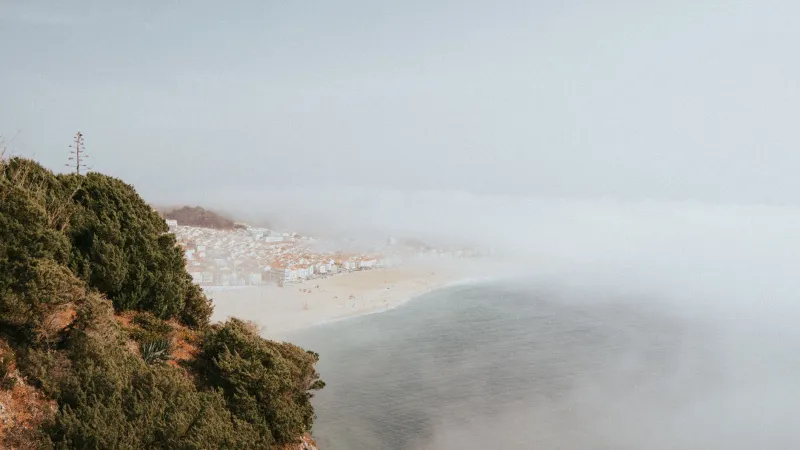
The landscape itself is part of it. The Serra de Monchique rises sharply from the flat coastal plain, and the shift in environment is genuinely dramatic. Eucalyptus and medronho (the wild strawberry tree that produces the region's famous firewater) crowd the hillsides. The air smells different — cooler, greener, with a faint resinous quality that feels almost medicinal. Mist rolls through the valleys in the morning. It's a landscape that asks something of you, and what it asks is that you pay attention.
What They're Not Finding Anywhere Else
There's a useful contrast that repeat visitors keep making: Monchique versus everywhere else they've tried to "decompress."
Mark, a physician from Chicago who now visits every other spring, has done the wellness resort circuit. He's been to Sedona. He's tried the digital detox retreats. "All of those places are selling you the idea of slowing down," he says. "Monchique just is slow. Nobody's packaging it for you. You have to figure out what to do with the quiet yourself, and that turns out to be the whole exercise."
This distinction matters more than it might sound. American vacation culture has become extraordinarily good at commodifying rest — selling it back to us in the form of curated experiences, structured itineraries, and $40 sound baths. What Monchique offers instead is something closer to unstructured time in a place that happens to be beautiful and historically rich and largely unbothered by the machinery of mass tourism.
The trails are there if you want them — the route up to Fóia, the highest point in the Algarve, rewards early risers with views that stretch to the Atlantic on clear days. The food is there: slow-roasted cabrito (kid goat), honest local wine, the kind of lunch that turns into a three-hour afternoon without anyone minding. But none of it is being pushed at you. You choose your own pace, and for a lot of Americans, that turns out to be a genuinely novel experience.
The Villages Do Something to You
Monchique town itself is small — a few thousand residents, a main square, a Friday market that's been running longer than the United States has existed. Caldas de Monchique, a spa village a few kilometers south, has the slightly suspended quality of a place that peaked in the 19th century and decided it was fine with that.
These aren't Instagrammed-to-death destinations. The streets are narrow and occasionally confusing. The signage assumes you're probably Portuguese. The old men playing cards outside the café are not performing local color for tourists; they're just playing cards.
And somehow that authenticity — that sense that the place exists for its own reasons, not for yours — is exactly what keeps people coming back. "I think I keep returning because it's one of the only places I've been where I feel like a guest rather than a customer," says Jennifer, a teacher from Seattle on her third visit. "The place isn't trying to please me. It's just being itself, and I find that really... restoring."
The Accumulation Effect
There's another pattern worth noting: repeat visitors consistently say that Monchique deepens with familiarity rather than losing its novelty. This is unusual. Most destinations work the other way.
On a first visit, people tend to hit the obvious markers — the viewpoint at Fóia, the thermal waters at Caldas, maybe a day trip down to the coast. On second and third visits, something shifts. They find the smaller trails that don't appear on any app. They figure out which café makes the best bifanas. They learn to read the weather, which in the mountains changes faster than on the coast and rewards people who've been paying attention. They start recognizing faces.
"The first time, I was a tourist," Mark says. "By the third visit, I felt like I was somewhere I actually knew. That's a feeling I haven't gotten anywhere else in my adult life."
What People Are Actually Looking For
If there's a through-line in all of these conversations, it's this: the Americans who return to Monchique aren't chasing novelty. They're chasing something closer to continuity — a place where they can pick up where they left off, go a little deeper, and feel the particular satisfaction of knowing somewhere well.
In a travel culture that's increasingly optimized for the new, the shareable, and the bucket-list-checkable, Monchique offers something almost countercultural: a destination that rewards loyalty, that gives more the more you give it, and that has absolutely no interest in competing for your attention.
Maybe that's the real Monchique effect. Not that the place is perfect — it isn't, and the people who love it will tell you that readily — but that it's genuinely, unhurriedly itself. And for Americans running on fumes from years of optimized, maximized, always-on living, that turns out to be exactly enough.
