Your Brain on Mountains: The Science Behind That Feeling You Get in Monchique
You've probably heard someone come back from a hiking trip and say something like, "I just think better up there." Maybe you've said it yourself. It sounds like the kind of thing people say after a good vacation — a nice story, nothing more. But researchers who study how environments affect cognition are starting to take a harder look at exactly that claim. And what they're finding is genuinely interesting, especially for anyone who's spent time in a place like the Monchique mountains.
There's something that happens to people here. Call it the Monchique Effect if you want a name for it. Guests at mountain accommodations throughout the Serra de Monchique consistently describe a shift — not just relaxation, but something sharper. A quieting of mental noise. A return of creative thinking they'd forgotten they had. The kind of focus that makes you wonder why you ever thought you needed a productivity app.
So what's actually going on?
Altitude and the Brain: More Than Just Thin Air
Monchique sits at elevations ranging from around 400 to nearly 900 meters, with Fóia — the highest point in southern Portugal — topping out at 902 meters. That's not Himalayan altitude, but it doesn't need to be. Research suggests that even moderate elevation changes can influence brain function in ways that go beyond simply "getting away from it all."
At higher altitudes, your body responds to slightly lower oxygen availability by increasing cerebral blood flow. Studies published in journals like High Altitude Medicine & Biology have shown that moderate altitude exposure can enhance certain cognitive functions — particularly those linked to attention and processing speed — as the brain adapts to its new environment. The effect is subtle at lower elevations, but it's measurable.
More importantly, the brain's response to novelty and environmental change is well-documented. When you step into a genuinely different landscape — different air pressure, different sounds, different visual depth — your default mode network (the brain circuit associated with mind-wandering and rumination) tends to quiet down. What replaces it is something closer to present-moment awareness. In neuroscience terms, you're shifting from default mode to a more task-positive state, even if the "task" is just walking a trail.
The Negative Ion Effect: Real or Hype?
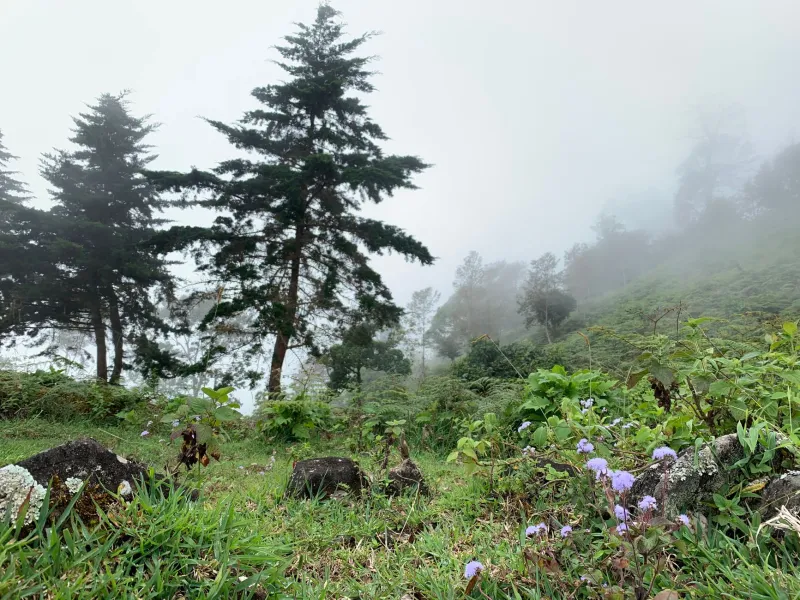
Here's where it gets interesting for hikers specifically. Monchique is home to natural spring water, dense eucalyptus and cork oak forests, and a microclimate that brings regular mist and moisture rolling in from the Atlantic. All of that matters because of something called negative ions.
Negative ions are molecules that carry an extra electron. They're produced naturally in environments with moving water, forests, and coastal air — all of which Monchique has in abundance. Research from Columbia University and other institutions has linked elevated negative ion concentrations to increased levels of serotonin in the brain, which plays a major role in mood regulation, focus, and emotional resilience.
A widely cited study found that exposure to high-density negative ion environments reduced symptoms of depression comparably to some pharmacological interventions. That's a significant finding. It also helps explain why people consistently report feeling better — not just calmer, but clearer — after spending time in forested mountain environments rather than urban ones.
The air in Monchique's hills isn't just clean in the obvious sense. It's chemically different from what most Americans breathe on a daily basis. And your brain notices.
Sensory Reduction and Cognitive Recovery
There's a concept in environmental psychology called Attention Restoration Theory, developed by Rachel and Stephen Kaplan at the University of Michigan. The basic idea is that directed attention — the kind you use when you're managing emails, navigating traffic, or sitting in back-to-back meetings — depletes a finite cognitive resource. Natural environments, particularly ones that are visually complex but non-threatening, allow that resource to replenish.
Monchique checks every box in this framework. The landscape is layered and endlessly varied — terraced hillsides, sudden valley drops, eucalyptus canopies, stone walls threading through the undergrowth. There's no grid to follow. No notification to respond to. Your eyes and ears are engaged, but gently, without demand.
Studies conducted in Japan on the practice of shinrin-yoku (forest bathing) have shown measurable reductions in cortisol levels, blood pressure, and heart rate after just 20 minutes in a forested environment. Similar research out of Stanford found that walking in natural settings reduced neural activity in the subgenual prefrontal cortex — the brain region most associated with repetitive negative thinking, or what most of us just call rumination.
For Americans who arrive in Monchique already carrying the cognitive load of a workweek (or a year), the shift can feel almost immediate. It's not placebo. The environment is doing something.
Why This Matters for How You Plan Your Trip
Understanding the science behind why mountain environments affect cognition changes the way you might approach a stay in Monchique. This isn't just a scenic backdrop for a hiking selfie. The trails here — many of them quiet, shaded, and well away from any road noise — are functioning as something closer to a neurological reset.
That has practical implications. If you're coming to Monchique partly to recover from burnout, to think through a big decision, or simply to feel like yourself again, the research suggests you'll get more out of it by slowing down than by cramming in activities. A two-hour walk through the forest above Caldas de Monchique will do more for your prefrontal cortex than a packed itinerary ever could.
It also means that where you stay matters. Properties nestled into the hillside, surrounded by trees, close to running water — these aren't just aesthetically appealing choices. They're environments that actively support the cognitive shift you came here for.
The Part No Study Can Fully Explain
Here's an honest caveat: science can measure cortisol and serotonin and neural activity, but it hasn't fully cracked what people mean when they say a place changed something for them. Monchique visitors often describe insights or creative breakthroughs that feel disproportionate to a hiking trip. Writers who finish chapters they'd been stuck on for months. Engineers who solve problems they'd been circling for weeks. People who make decisions they'd been avoiding for years.
The neuroscience gives us a framework — restored attention, reduced rumination, increased serotonin, heightened present-moment awareness. Put all of that together and you have a brain that's simply better positioned to do what it does best: make connections, generate ideas, process emotion without getting tangled in it.
Monchique provides the conditions. Your brain does the rest.
Maybe that's the simplest way to put it. The mountains don't give you anything new. They just get out of the way long enough for you to remember what was already there.